
Google has announced an updated version of its open source Android Automotive operating system designed for software-defined vehicles. Previously limited to in-car infotainment systems, Android Automotive is now being extended to support non-safety-critical components within the vehicle’s internal computing architecture, broadening its role as an “open infrastructure.” This strategic move comes with a new and straightforward name: Android Automotive OS SDV, short AAOS SDV. As platforms like this evolve into critical infrastructure, governance matters as much as code.
As Matt Crowley, Group Product Manager at Android Automotive, explains in the announcement:
“Today, to help our partners realize their full SDV vision, we’re extending AAOS beyond the car’s screen with Android Automotive OS for Software Defined Vehicles (AAOS SDV). This new foundation, built in collaboration with our automotive partners, provides an open infrastructure for the non-safety parts of vehicles—allowing carmakers more choice and time to focus on delivering unique experiences and innovations their customers love.”
For the open source automotive community, this argument is hardly new. By now, the “don’t reinvent the wheel” narrative has become a given and the raison d’être of OSS automotive ecosystems such as Eclipse SDV: collaborate on non-differentiating software while maintaining a competitive edge through differentiated services and applications. A key aspect to watch, however, will be the governance model chosen for AAOS SDV.
Single vendor or foundation-based open source?
Apache 2 is the preferred license for the majority of the Android platform, while we do not know as yet under what license will the AAOS SDV be released. Access appears to be primarily oriented towards Google’s “automotive partners,” rather than the broader ecosystem or interested contributors.
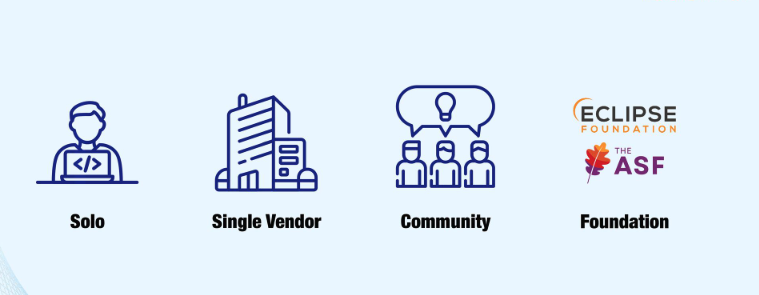
From the information at our disposal, the model is the well established “single vendor open source.” What does this mean?
Single vendor open source is characterised by a company-led approach where one organisation retains primary control over governance, roadmap, and licensing. It can provide clear direction and execution efficiency, but it also centralises decision-making within a single stakeholder.
In contrast, foundation-based open source involves projects hosted by independent, formal organisations like the Apache Software Foundation or the Eclipse Foundation. These projects operate under a governance that is established and meritocratic and allows contributions from multiple companies and individuals. This structure is often preferred for “critical infrastructure” (e.g., Kubernetes, Eclipse S-CORE, Jakarta EE) because it ensures long-term stability, shared ownership, and a level playing field where no single entity can unilaterally control the project or its future direction.
The Eclipse Foundation governance is built around the open source principles of openness, transparency, and meritocracy, and ensures vendor neutrality. In a nutshell, software should be a shared resource that remains available, secure, and stable through collective effort.
One vendor to rule them all?
While the approach of open sourcing non-differentiating automotive software – essentially the same strategy pursued by integration projects such as Eclipse S-CORE in recent years – is laudable, the key question remains whether it will result in a multi-vendor ecosystem or a single-vendor open source model.
Both are valid approaches that come with different trade-offs. However, the relatively short yet eventful history of open source software offers many examples of single-vendor ecosystems gone wrong. Without mentioning any names, we have seen that dominance by a single organisation carries inherent risks: abrupt or ill-considered license changes, control over the project’s roadmap, or even the discontinuation of a project due to shifting priorities, strategic realignments, or mergers.
Frédéric Ameye, former leader of the Ampere/Renault SDV platform, rightly notes that “when Google goes somewhere, things can change fast, at a large scale.” However, the logic of “too big to fail” does not apply here. The success of a single organisation is no guarantee of a sustainable open source project or ecosystem, as vendor neutrality is often a key factor for any initiative that truly deserves the label “open source.”
Communities, the bus factor, and functional safety
We have highlighted the difference between single vendor and foundation-led open source. Neutrality, along with a level playing field, can only be ensured under the stewardship of an independent organisation with no commercial stake, supported by a diverse community that optimises the “bus factor,” referring to the number of stakeholders whose departure would jeopardise the project’s survival. A good bus factor means that knowledge and code is shared among many individuals or entities, so the project can continue and succeed even under highly adverse circumstances.
A community-driven approach to software development reduces reliance on any single vendor while fostering collaboration and shared learning. With more contributors reviewing the code, issues are identified and resolved more quickly, enabling maintainers to deliver software that is robust, interoperable, and secure, reinforcing Linus’s Law that “given enough eyeballs, all bugs are shallow.” What’s more, this level of public scrutiny, openness, and transparency enables the automotive software community to boldly go where no open source automotive ecosystem has gone before – into safety-critical software, a domain that Crowley explicitly excludes from AAOS SDV in his statement.
The road to openness and EU digital autonomy runs through vendor-neutral governance
In the end, Google’s move may well accelerate momentum in the SDV space. But it also brings the unresolved question of governance into sharper focus. Whether AAOS SDV develops into a truly open, inclusive, sustainable multi-vendor ecosystem or remains Google-centric and focused on bilateral, exclusive partnerships will shape its long-term impact. In an industry increasingly built on collaboration, the real opportunity lies not just in sharing code, but in sharing control, grounded in neutral governance that only established open source organisations can guarantee. The Memorandum of Understanding signed in January by 32 automotive companies is a clear signal that the industry is currently leaning toward a vendor-neutral governance model.
As a European open source foundation, we are aware of the growing importance of resilience, neutrality, and long-term sustainability in the automotive sector. Strengthening open, collaborative ecosystems is key to reducing strategic dependencies and ensuring that innovation remains transparent, adaptable, and broadly accessible. A foundation governed by open source principles provides a durable framework to support these goals and foster a more balanced and sustainable industry landscape.