15 years ago, I would have loved to attend an automotive hackathon. Today, I’m helping organise one. And this year’s edition showed me just how far we’ve come.
Back in 2011, when I was studying at university, hackathons were hardly a thing in the European automotive and embedded software world. At least from my perspective, opportunities were extremely limited. I remember coming across events in Berlin and the Netherlands, but nothing that really connected my interests in embedded systems, automotive software, and hands-on experimentation.
Imagine being a student who loves programming, electronics, and cars, but has no real opportunity to combine all three together with people from the industry.
Fast forward 15 years.
From 6–8 October, 2026, we brought together 57 developers, students, automotive professionals, and open source enthusiasts at Zeppelin University in Friedrichshafen, Germany, for Eclipse SDV Hackathon Chapter Four, hosted by the ZF Group.
Ten teams. Three days. Plenty of code, debugging, coffee, and probably a few moments of questioning our life choices.
But this year something was different.
Actually, two things.
Almost three out of four participants were professionals. And for the first time, teams could bring their own challenges through our new Freestyle Track.
Both developments deserve a closer look.
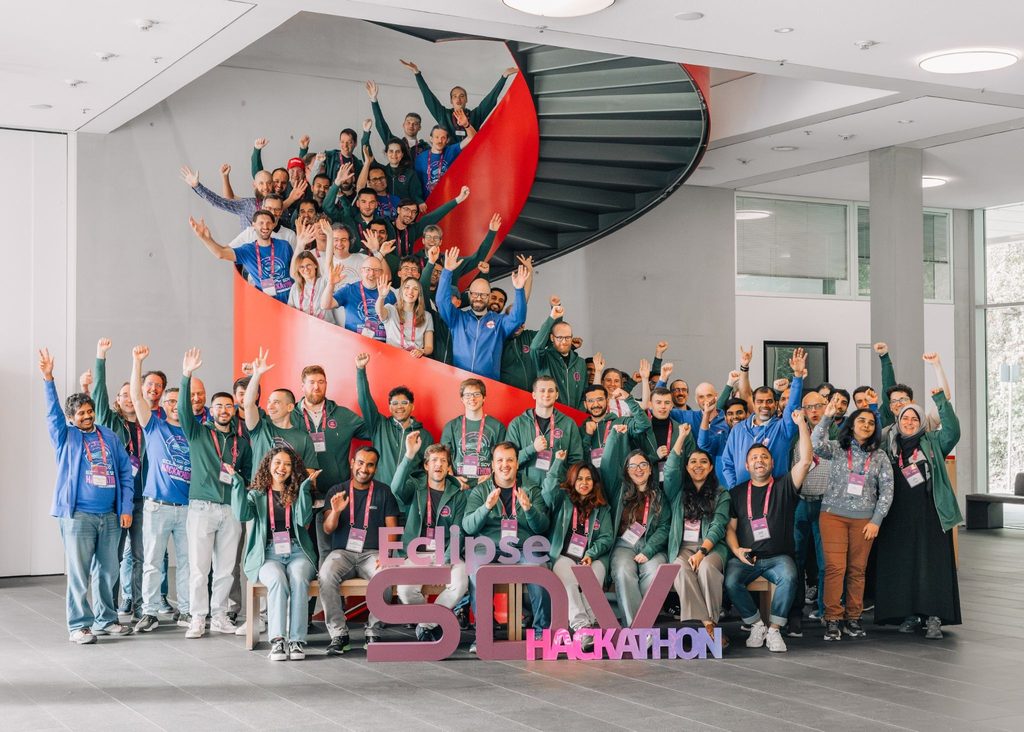
Group photo from Friedrichshafen https://flic.kr/p/2sEQFc8
73% professionals. Wait, isn’t this supposed to be a hackathon?
When we started preparing Chapter Four, I certainly didn’t expect this ratio.
Out of 57 participants onsite, 42 were professionals and 15 were students.
And these weren’t just people dropping by to observe. Developers and engineers from companies across the automotive ecosystem spent three days coding, experimenting, and collaborating.
We had participants from organisations including Mercedes-Benz Tech Innovation, Cummins, FEV.io, RT-RK, ZF, Schaeffler, TRATON, Capgemini, Allison Transmission, AUMOVIO, and SiliconAuto.
For me, this is an interesting signal.
Hackathons have traditionally been associated with students, universities, and young developers trying out new technologies. And I still believe they are fantastic opportunities for students to get in touch with real engineering challenges.
But seeing this many experienced automotive developers joining voluntarily tells me something else:
There is a real appetite for getting hands-on with open source software outside the boundaries of everyday development projects. For industry professionals, hackathons offer a unique playground where they can test new ideas and explore possibilities without the usual constraints.
No lengthy alignment meetings. No endless PowerPoint discussions. No waiting for the next project milestone.
Just developers, technology, and a problem worth solving.
Of course, having so many professionals in the room also changes the dynamics. People bring years of experience with embedded development, diagnostics, middleware, architectures, and production systems.
But I particularly enjoyed seeing students and professionals working side by side. Experience matters, but so does curiosity, and sometimes the person asking the most useful question is the one who hasn’t spent 15 years working on the same problem.
The Freestyle Track: Bring your own challenge!
For previous editions, we largely provided the challenges and asked teams to come up with creative solutions.
This year, we tried something different.
Alongside our Innovation Track, we introduced the Freestyle Track.
The idea was pretty simple: Instead of having to follow one of our predefined challenges, teams could bring their own ideas, tackle problems they had already identified, and build something useful for the Eclipse SDV community.
And it worked.
Four out of ten teams chose Freestyle.
That’s 40% of all teams deciding to work on something they were personally interested in bringing forward.
What excited me most wasn’t just the number.
It was the direction those teams took.
Instead of building isolated prototypes that might disappear into a GitHub repository after the event, teams worked toward direct contributions to existing Eclipse SDV projects.
Pull requests. Feature proposals. Improvements to existing software.
Not just using open source. Contributing back to it.
For me, this might be the most important development of Chapter Four.
A hackathon is great when it generates exciting ideas. But it becomes even more valuable when those ideas have a chance to live beyond the closing ceremony.
And this is exactly how I would like to see our SDV Hackathons evolve.
Two tracks, different approaches, and some impressive results
With the Innovation and Freestyle Tracks running independently, we had two competitions and two different ways for teams to demonstrate their skills.
Innovation Track: Bare Metal Mafia takes first place!
First place went to Bare Metal Mafia, a team consisting entirely of students.
Yes, you read that correctly.
At a hackathon with 73% professional participation, an all-student team took the top spot in the Innovation Track!
Their solution, *Guardian Loop*, addressed vehicle safety scenarios involving situations such as a child left behind in a car or a hot cabin.
Their approach followed a simple principle:
Swap the hardware, never the logic.
The architecture separated sensing, decision-making, and actuation. By using adapters and clear interfaces, the solution could support different hardware and vehicle integration scenarios.
And honestly, I love seeing students think about software architecture this way, rather than simply connecting a few components and calling it a prototype.
Congratulations to Bare Metal Mafia!
Explore their winning pitch and technical approach.
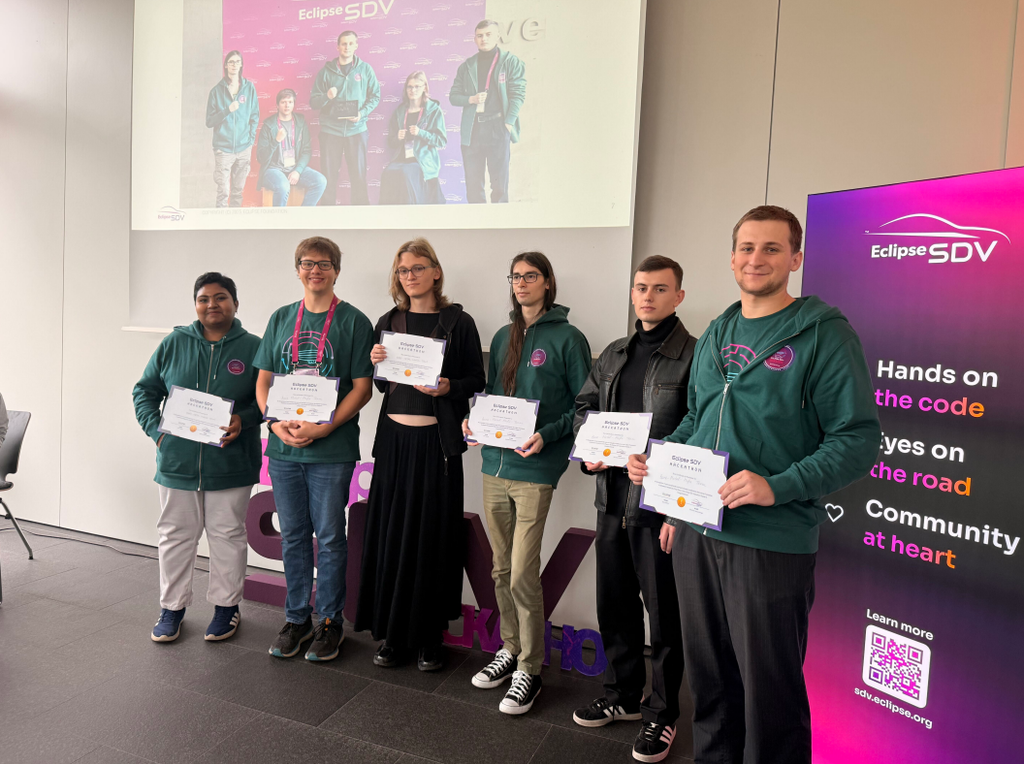
Bare Metal Mafia winning team
Innovation Track: Second place goes to RoM
Second place went to Revolution of Mobility (RoM), a team combining participants from RT-RK with two students.
Their project, *Battery Thermal Guardian*, demonstrated a thermal monitoring and warning solution bringing together several Eclipse SDV technologies.
The solution combined thermal monitoring, fault detection, diagnostic recording through Eclipse OpenSOVD, communication using Eclipse uProtocol, and supervision through Eclipse Ankaios.
What I particularly liked was the focus on integrating several building blocks into one working system.
Because that’s exactly one of the challenges we face in software-defined vehicles: Making individual technologies work together in practical architectures.
Take a look at the RoM project pitch.
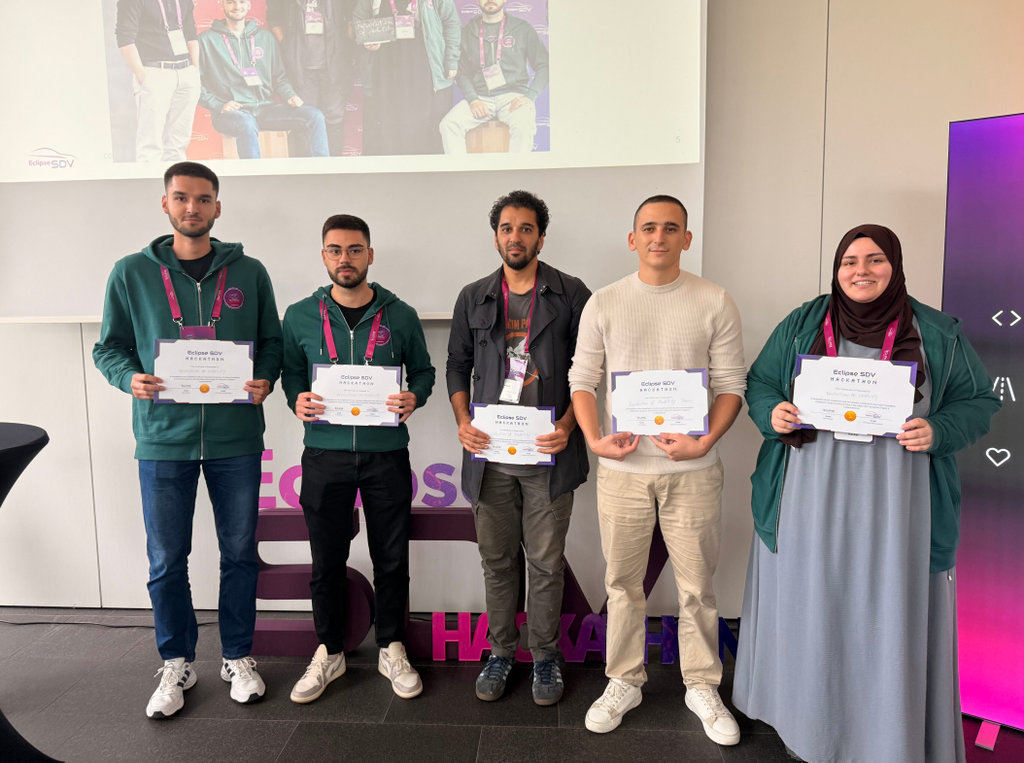
Revolution of Mobility team
Freestyle Track: Thinking_CAPs wins the first edition!
Our first-ever Freestyle Track was won by Thinking_CAPs, a team from Capgemini.
Their work brought together three objectives: contributing their expertise to the open source community, sharing their vision of an AI Software Factory for automotive development, and introducing ideas such as X-Verse to help accelerate SDV adoption.
It’s a good example of why we introduced this track.
Sometimes a team already has an idea worth exploring. Why force them into a predefined challenge when we can provide a platform to develop it together with the community?
Congratulations to Thinking_CAPs for becoming our first Freestyle Track winners!
You can find their pitch and ideas on GitHub.
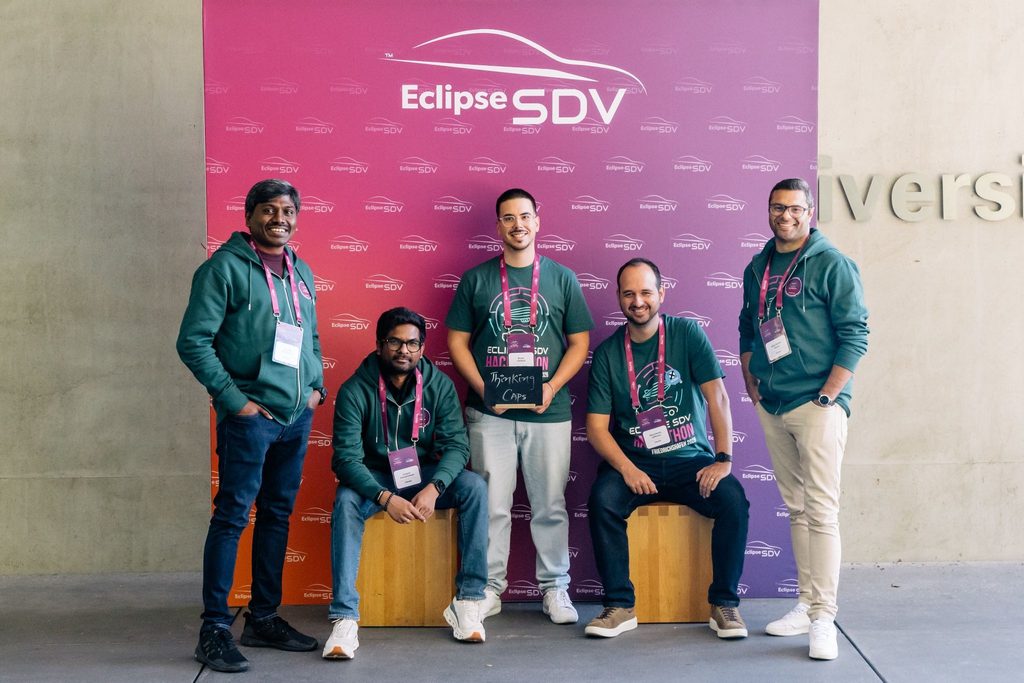
Thinking_CAPs winning team in the Freestyle Track https://flic.kr/p/2sEWxsj
The real winners? The code that stays.
Last year, I wrote about the 2025 SDV Hackathon finalists and winners, encouraging everyone to explore their solutions on GitHub.
And I still think that’s important.
But after Chapter Four, I would go a step further.
The biggest success of a hackathon is not necessarily the prototype with the most impressive demo or the team taking home the first prize.
It’s what happens afterwards.
Does someone continue developing the idea? Does a feature make it into an existing open source project? Does a pull request get merged? Do two developers from different companies continue collaborating after the event?
That’s when a three-day hackathon starts creating longer-term value.
And with four Freestyle teams working toward direct community contributions, we have a promising starting point.
Of course, getting code into production-quality open source projects takes more than three days. Reviews, testing, documentation, maintainability, and community alignment still matter.
But you have to start somewhere.
And I’d much rather start with working code and people excited about contributing than another set of slides describing what we could potentially do.
A big thank you!
First of all, a huge thank you to ZF Group for hosting us in Friedrichshafen and making Chapter Four possible.
Thanks also to all the participating and supporting companies, our SDV Working Group members, everyone involved in organising the event, our jury members, and especially our Hack Coaches.
And finally, thanks to all 57 participants.
You brought your ideas, your experience, your creativity, and your willingness to share knowledge. You made this event what it was.
If you want to get an idea of the atmosphere, the teams, and everything happening beyond the code, have a look at our photo collection:
📸 Eclipse SDV Hackathon 2026 – Friedrichshafen: Photo Album
Chapter Five? Yes, it’s coming in
November 2027!
More details soon.
Until then: Keep hacking, keep contributing, and keep building software-defined vehicles openly!