
The Open Community for Automotive (OCA) at OCX 2026 focused on how open source collaboration is transforming the software defined vehicle ecosystem and enabling a full middleware platform for series vehicle production.
Across three days, the track moved from orchestration and operating system design to safety, cybersecurity, and real-world deployment. The discussions stayed grounded in implementation, following the mantra of “code-first.” The question was not what SDV could become, but how current systems are being built, integrated, and maintained in a sustainable manner.
Key topics from the event
A few patterns came up consistently:
- The challenge is no longer building components, but integrating them into working systems, that are usable in a mixed criticality system
- Cybersecurity and safety are key concerns and need to be addressed and supported by processes and toolchains
- Orchestration is confirmed as a central topic of interest and highlights the synergies with the cloud native domain
- Open source is becoming the default for non-differentiating layers, but requires clear governance and good citizens
Alongside the main sessions, the track also included hands-on workshops that focused on interacting with the experts and round tables to gather the needs of the community at large.
The Eclipse Trustable Software Meetup brought together practitioners to examine how software risk can be assessed and improved in complex systems, including its overlap with cybersecurity, compliance, and the CRA. The participants discussed how the Trustable Software Framework can be adopted in an automotive organisation framework.
In parallel, the SDV enablement for commercial vehicle use cases workshop explored how open source approaches translate into measurable impact across fleet management, safety, and operational efficiency. These sessions moved from architecture discussions to practical architecture set-up, leaving room for for deeper technical exchange and concrete use cases beyond the main stage.
Other tracks at OCX26
This track sits alongside the collocated events, each focused on a specific domain within the Eclipse Foundation ecosystem. These tracks explored the same challenges from different technical angles, with a stronger focus on domain-specific implementation and tooling.
- Main track (read the OCX26 highlights)
- Open Community for Tooling (read the OCX26 highlights)
- Open Community for AI (read the OCX26 highlights)
- Open Community for Compliance (read the OCX26 highlights)
- Open Community for Research (read the OCX26 highlights)
- Also, don’t miss our keynotes recap (read the OCX26 highlights)
Below is an overview of the OCA agenda, with links to the recordings. Make sure to check them out!
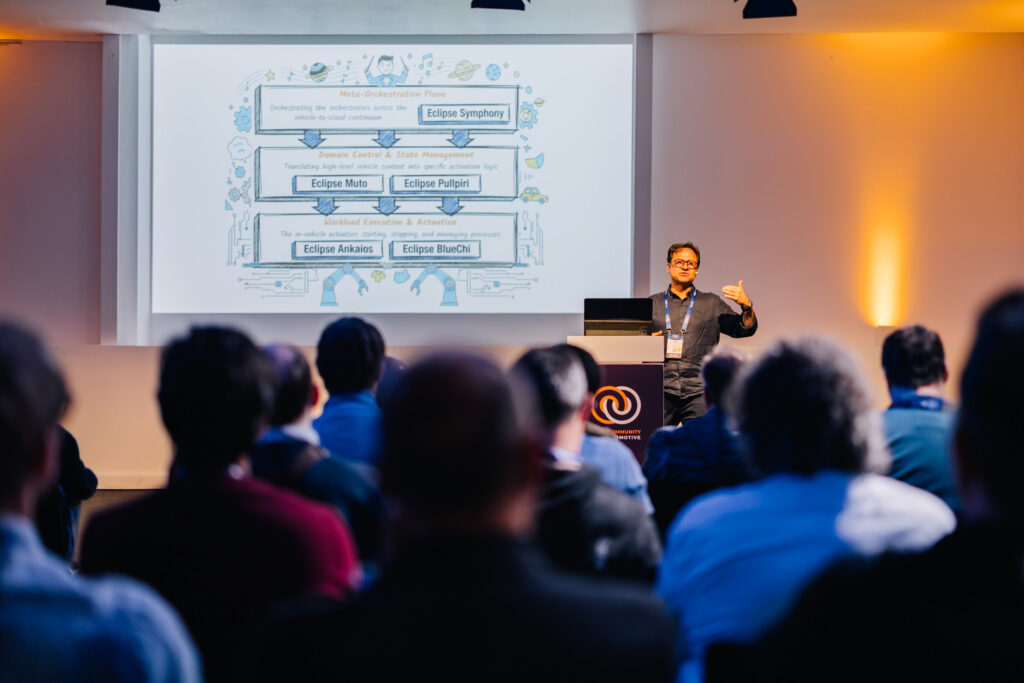
Day 1 at Open Community for Automotive: Highlights
Fifty shades of SDV: A blueprint-driven roadmap for orchestration adoption with Nai Dai
How is OS integrity achieved in the Red Hat in-vehicle operating system? with Pierre-Yves Chibon and Leonardo Rossetti
Challenges for the cybersecurity of operating systems in the SDV with Michael Schneider
Day 2 at Open Community for Automotive: Highlights
Open source basics for automotive with Harald Mackamul and Andy Riexinger
Towards an open source, functionally safe software stack for the Software Defined Vehicle with Dr Oliver Pajonk
Open roads ahead: Collaborating on an SDV reference implementation for commercial vehicles with Carlton Bale and Priya Gurunathan
Day 3 at Open Community for Automotive: Highlights
openDuT: The Open-Source Revolution for Distributed ECU Testing with Michael Plichta and Pascal Hirmer
Capella & SysON: The MBSE Force Awakens with Etienne Juliot
You are the jam: real traffic data in a simulated world with Michael Behrisch and Robert Hilbrich
My takeaway
I’m personally proud of the automotive community and on how open and constructive the interactions were. No presenter left the stage without multiple technical questions. This is a turning point for open source in the SDV domain, as most of the needed building blocks already exist, but turning them into series-ready platforms requires alignment across multiple layers, most importantly on the process side. As we move towards adoption in a series setting, the safety and cybersecurity aspects take a central role, and need to follow a process as well as be supported by a set of tools. The Eclipse Trustable Software Framework and the Eclipse S-CORE process development are clear signs of this evolution.
I’m excited to see our community expanding towards commercial vehicles use cases, and looking into its specific needs. The sessions explored the synergy with the cloud native domain, highlighting the need of reaching outside the automotive silo, to exploit development speed and quality.
I’m thankful to the OCA Program Committee for their hard work in getting the excellent program together under the guidance of Andreas Riexinger.
I’m indeed looking forward to next year’s OCA!
If you missed one of the sessions from the Open Community for Automotive, you can now see them on the OCX YouTube channel:
For more impressions, check out the OCX photo albums.


