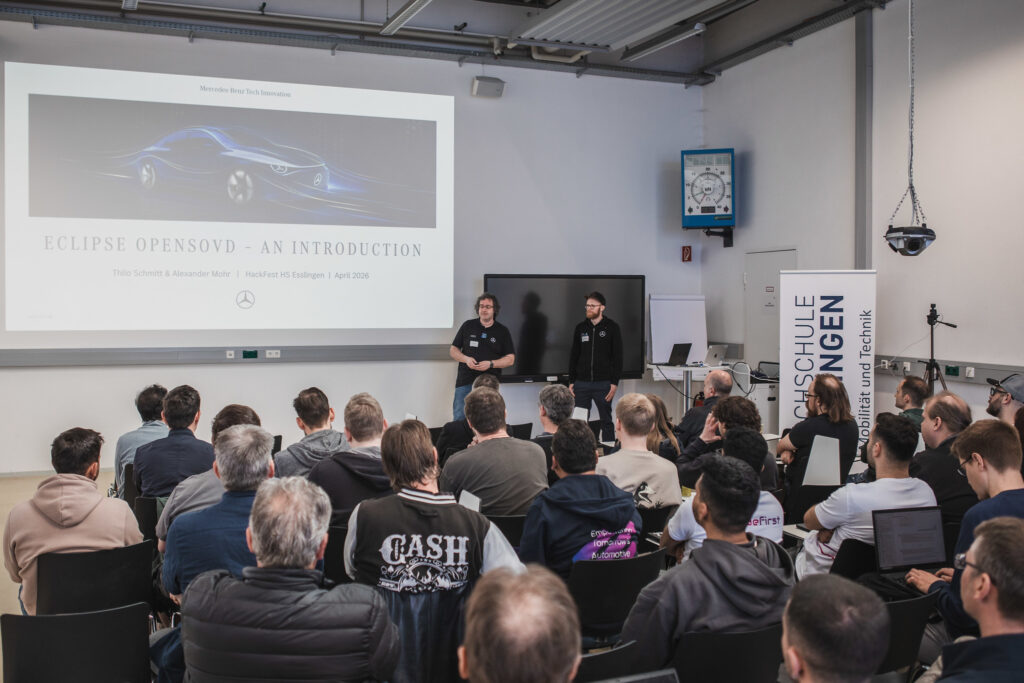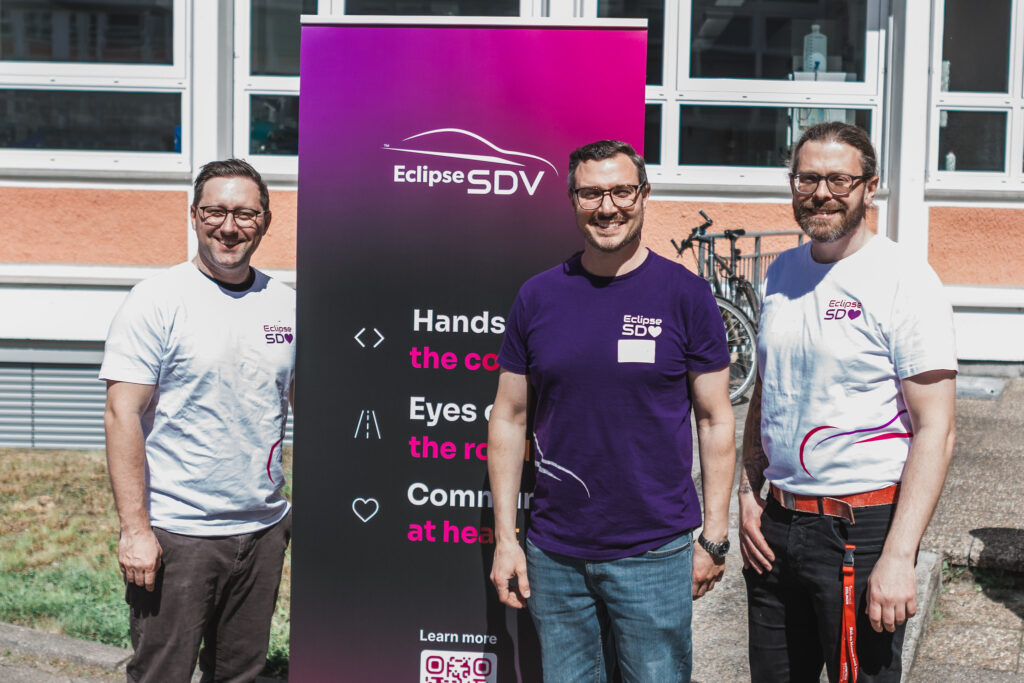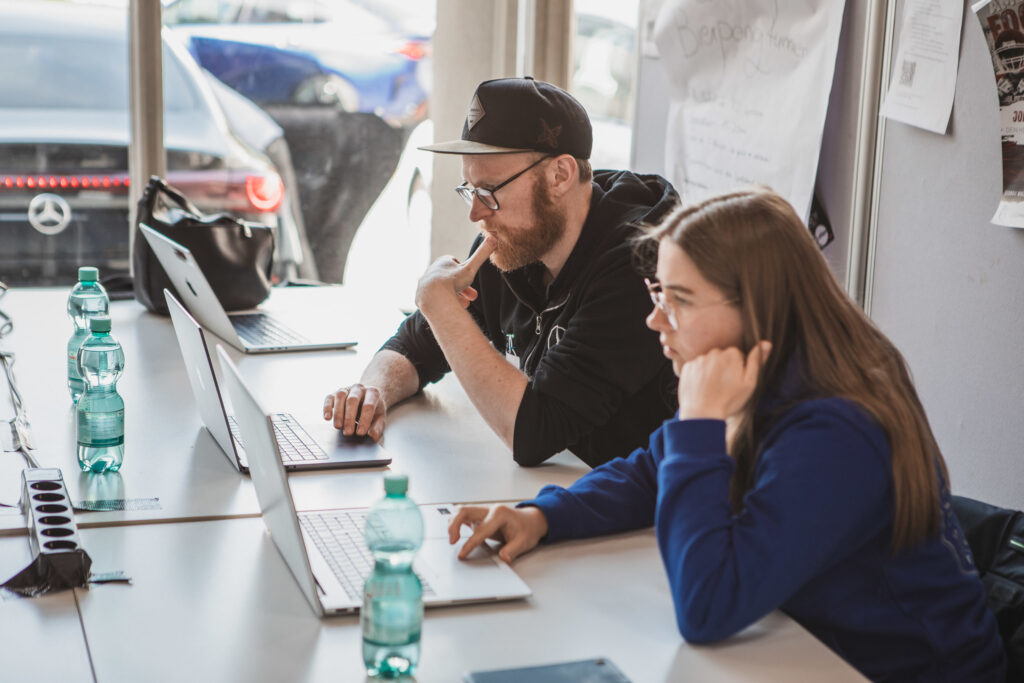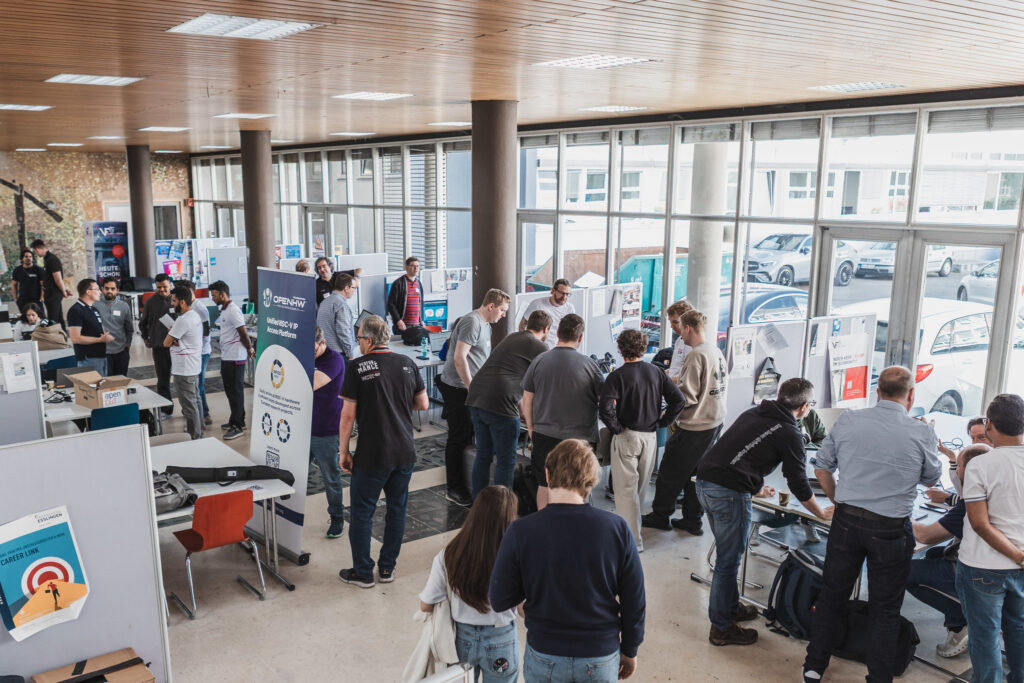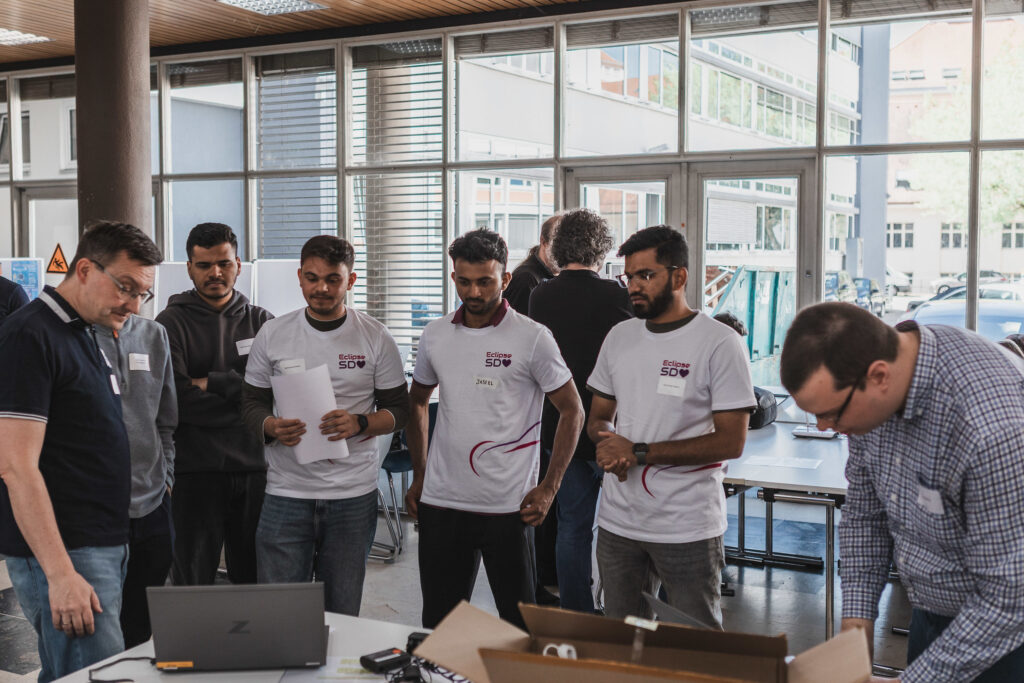

On 28-29 April 2026, the Eclipse SDV community gathered at Esslingen University, Campus Stadtmitte, for the SDV HackFest HS Esslingen to strengthen the SDV ecosystem and project adoption. Around 50 participants from industry, academia, and the Eclipse SDV project community came together for two days of hands-on work on software-defined vehicle technologies. The event focused on accelerating Eclipse SDV projects, working directly with open source components, and tackling integration and testing tasks together with project maintainers and mentors.
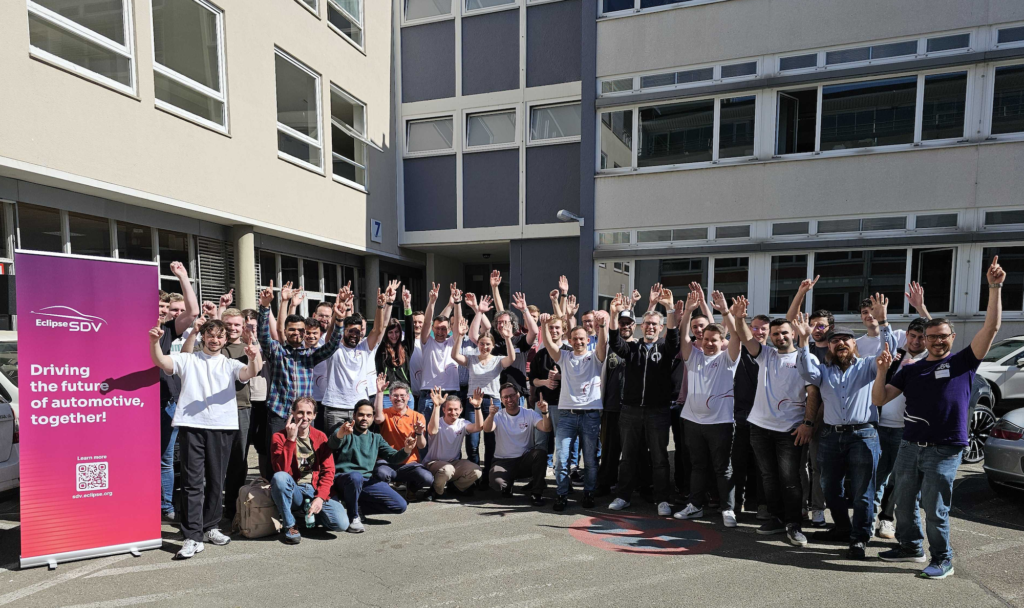
Unlike a hackathon, this HackFest was not built around competing teams, predefined challenges, judging criteria, or winners. Instead, the goal was to try ideas on a shared technical architecture, bring projects closer together, and find out what works — and what still needs work — when SDV components meet real vehicles, virtual setups, embedded platforms, and diagnostics tooling.
From target architecture to working integration
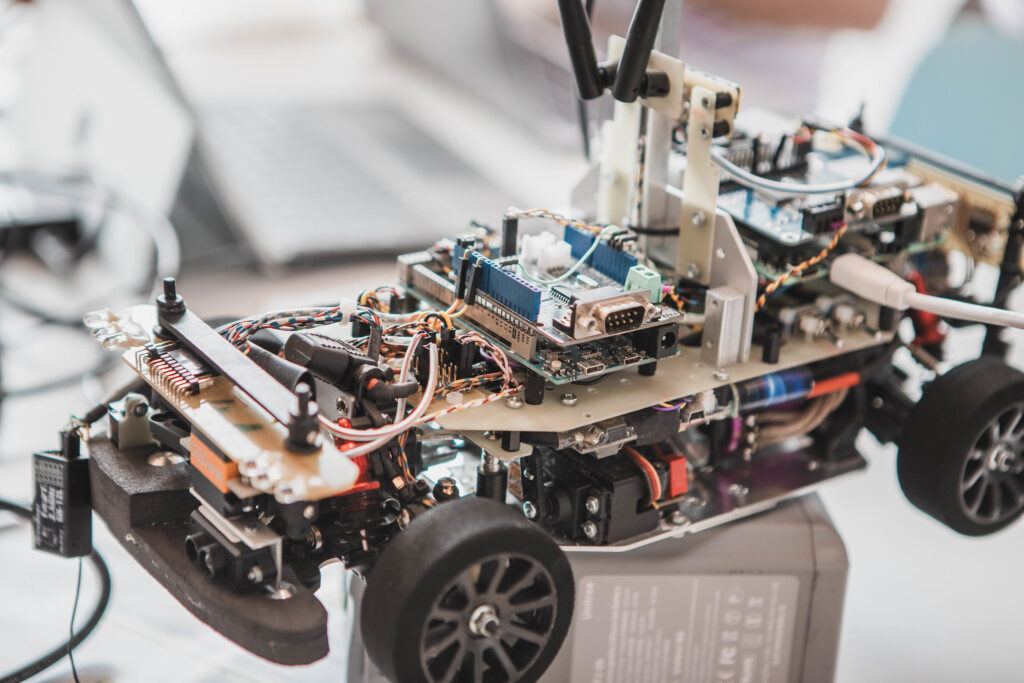
The starting point for the HackFest was a shared target architecture connecting several Eclipse SDV projects and vehicle environments. The setup included Eclipse OpenSOVD, Eclipse S-CORE, Eclipse OpenBSW, Eclipse openDuT, diagnostics servers, UDS communication, build toolchains, virtual vehicles, 1:10 scale vehicles, robots, and real OEM vehicles from Mercedes-Benz, BMW, and Porsche.
Day one began with technical introductions and hardware onboarding. Participants then formed teams around concrete work packages, ranging from OpenSOVD demonstrations and S-CORE integration to openDuT-based connectivity and advanced debugging. The event page also announced an introduction session for the four Eclipse projects involved, supporting participants in quickly finding their way into the technical scope.
The projects involved covered key layers of the SDV stack: Eclipse OpenSOVD provides an open source implementation of the Service-Oriented Vehicle Diagnostics standard; Eclipse S-CORE aims to create a common, safety-critical runtime foundation and software platform for SDVs; Eclipse OpenBSW provides an embedded basic software stack for microcontrollers; and Eclipse openDuT enables distributed, reproducible testing of ECUs and virtual/physical test setups.
The integration tracks were …
Eclipse OpenSOVD × S-CORE: bringing middleware and diagnostics together
One major track focused on the integration of Eclipse OpenSOVD and Eclipse S-CORE. The teams made first strides toward building OpenSOVD as part of S-CORE and identified a number of valuable learnings and integration challenges.
A particular highlight was the end-to-end demonstration of S-CORE with OpenSOVD on top of EB corbos Linux using a Raspberry Pi. The project leads described this as an important first proof point for the combined stack.
Another notable result was a prototype in which vehicle functions were controlled using S-CORE as middleware and made diagnosable through OpenSOVD. Admittedly, the “vehicle” was an academic 1:10 RC car mock-up — but it was still a very tangible and motivating result.
The OpenSOVD teams also developed and demonstrated web-based UIs for interactive usage, reducing the need for command-line tooling. In addition, AI-assisted diagnostic workflows were explored through an AI chat interface and MCP server integration. The idea is to make diagnostic tooling easier to use not only for developers, but also for integrators, testers, and aftersales experts.
OpenSOVD × real vehicles: interoperability in practice
The HackFest also created a rare opportunity for direct interoperability testing with real vehicles from Mercedes-Benz, BMW, and Porsche.
The results were highly valuable: communication via the OpenSOVD Classic Diagnostic Adapter (CDA) worked in principle with all available vehicles. At the same time, the teams uncovered several diagnostic description challenges. Some issues were already fixed during or shortly after the HackFest, while others are still under investigation.
Full functionality was demonstrated on a Mercedes-Benz vehicle, with continued work ongoing to reach the same level of functionality for BMW and Porsche vehicles. This kind of real-world testing directly improves project quality, because it exposes the kinds of interoperability issues that rarely show up in isolated demos.
OpenBSW × OpenSOVD: diagnosing a virtual vehicle
Another team worked on an OpenBSW + OpenSOVD demo, connecting an OpenBSW-based virtual ECU with the OpenSOVD CDA and visualisation tooling. The demo architecture combines an OpenBSW ECU, an OpenSOVD CDA, and Grafana: the OpenBSW ECU simulates UDS diagnostic services over DoIP, the CDA translates the SOVD REST API to UDS/DoIP diagnostic commands, and Grafana visualises live sensor and fault data.
The resulting demo included simulated diagnostic trouble codes, sensor values, UDS services for reading and clearing diagnostic data, a SOVD REST API, Swagger UI, and Grafana dashboards.
This was one of the clearest examples of what the SDV HackFest was meant to achieve: not just talking about integration, but actually wiring components together and making the results visible.
openDuT: remote access, distributed testing, and debugging the testbench
The Eclipse openDuT track focused on distributed test environments and vehicle connectivity. For the HackFest, the openDuT team prepared Raspberry Pis with edge software installed, an openDuT backend, and several work ideas around remote ECU access, virtual CDA setups, and edge device setup.
The results showed both progress and useful friction. One setup established a CDA connection to a car via openDuT and was able to trigger vehicle behaviour — including folding mirrors from inside. The team also worked on RC car remote control via CAN, connected a S-CORE image to the internet, installed EDGAR natively on the S-CORE image, and identified several issues around configuration, NetBird sessions, CAN support, kernel modules, and documentation.
In other words: openDuT did exactly what a good test infrastructure project should do at a HackFest — enable experiments, reveal assumptions, and turn setup pain into actionable improvements.
“This was one of the clearest examples of what the SDV HackFest was meant to achieve: not just talking about integration, but actually wiring components together and making the results visible.“
Pains and gains
Of course, putting several active open source projects, real vehicles, virtual environments, embedded hardware, diagnostic descriptions, and build systems into one architecture is not frictionless.
The main pains were exactly where one would expect them:
- integrating across heterogeneous projects and toolchains;
- aligning diagnostic descriptions across different vehicle environments;
- debugging communication paths involving UDS, CAN, DoIP, CDA, and remote test infrastructure;
- dealing with setup issues around Raspberry Pis, container environments, network sessions, and kernel modules;
- clarifying where project boundaries end and integration responsibilities begin.
But these pains were also the gains.
The SDV HackFest brought maintainers, users, OEM experts, students, and tool builders into the same room. Issues were not only discussed; they were reproduced, debugged, and in some cases fixed. Several findings now feed directly into upstream project work, documentation improvements, interoperability discussions, and follow-up workshops.
One of the most important outcomes was that the involved projects moved closer together. OpenSOVD, S-CORE, OpenBSW, and openDuT were not treated as isolated components, but as parts of a broader SDV engineering workflow.
And the demos showed …
At the end of the HackFest, the demos reflected the experimental nature of the event. Not every result was polished, and not every integration was complete. But that was never the point.
The demos showed:
- OpenSOVD and S-CORE running together in an embedded setup;
- OpenSOVD-based diagnostics on a 1:10 vehicle mock-up controlled through S-CORE middleware;
- OpenSOVD diagnosing a virtual vehicle running OpenBSW;
- diagnostic reports being sent to backend systems and visualised;
- web-based and AI-assisted OpenSOVD interfaces;
- CDA communication with real OEM vehicles;
- openDuT-based connectivity for remote and distributed testing scenarios.
In a HackFest, success is not measured by a trophy ceremony. It is measured by whether the community leaves with more working code, better understanding, clearer issues, and stronger collaboration. By that measure, the Esslingen HackFest delivered.
Explore the code
Several results and playgrounds are already available publicly:
- Overview and Intro presentation
- openDuT playground: challenge overview and result overview
- OpenBSW + SOVD demo: demo repository and demo architecture documentation
The OpenSOVD UI and AI-assisted diagnostic work is planned to be made available upstream as soon as possible.
More impressions from SDV HackFest in Esslingen
The atmosphere on site was focused, collaborative, and very hands-on. Participants moved quickly from introductions and team formation into technical discussions, debugging sessions, and demo preparation. The presence of real vehicles, 1:10 platforms, Raspberry Pis, and project maintainers made the event feel less like a workshop and more like a temporary integration lab.
More impressions from the HackFest are available in the Flickr photo album.
Looking ahead to the SDV Hackathon
The SDV HackFest also served as an important stepping stone toward the next SDV Hackathon activities.
And our SDV Hackathon is going into the fourth iteration now! Save your spot here: https://www.eclipse-foundation.events/event/sdv-hackathon-chapter-four/
While the Hackathon format is ideal for creativity, new ideas, and broader use cases, the HackFest helped strengthen the technical foundation underneath. The integration work in Esslingen produced reusable demos, clearer project interfaces, known issue lists, and better alignment between projects. Future Hackathon teams can build on these results instead of starting from scratch.
A dedicated S-CORE × OpenSOVD workshop is already planned for May 20 at Mercedes-Benz Tech Innovation in Ulm to continue the integration discussions started in Esslingen.
Thank you!
A big thank you to Esslingen University, the Eclipse SDV community, the project leads and mentors from Eclipse OpenSOVD, Eclipse S-CORE, Eclipse OpenBSW, and Eclipse openDuT, and all participating companies and contributors.
Special thanks also go to our supporters: VdF Alumni + Friends Esslingen e.V. and ETAS GmbH
As well as to the partners who made real hardware, vehicles, expertise, and development environments available. The SDV HackFest showed once again that open source in the automotive domain becomes most powerful when people work across organisational boundaries – in code, in vehicles, and in the same room.